🧭 Exam Study Guide
My Email: robmgmte2700@gmail.com (reach out about anything!)
Direct link to this page: 2700.robmunger.com
Condensed slides and Formula Sheet: robmunger.com/2700share
How to navigate this website: 🧭 Finding Things
Using this Study Guide
Section titled “Using this Study Guide”This page includes exam information, study tips, and tips on how to use this website, condensed versions of Bruce’s slides (to save paper if you print) and links to the sections when we covered Problem Set solutions.
You can also access the pages through the sidebar ←. Notes from each section meeting and other resources can be found using the 🧭 Finding Things page.
During the review session, I give a guided tour of this site, but you can also just look through and use what you find most helpful.
Remember: This study guide is a work in progress and is just a companion to the live review session. You are responsible for everything covered during Bruce’s class meetings.
Exam Logistics
Section titled “Exam Logistics”Important information can also be found in your syllabus. Here is the information for the Spring 2026 Final Exam:
The final will be available on Canvas starting at 8:10 PM (US Eastern Time) on Tuesday, May 12. Students will have a 24-hour window, from 8:10 PM (US Eastern Time) on May 12 to 8:10 PM (US Eastern Time) on May 13, in which to complete the exam. The exam is two hours long, and, once begun, must be taken in one sitting. It cannot be partially finished, then saved, then completed later.
The final will be cumulative, and cover all the material presented in lecture, and in the corresponding chapters of the book, from the first lecture on January 27 to the last lecture on April 28. However, it will be weighted toward material presented since the midterm.
Section logistics: See this week’s ✅ Section Agendas page for the current section schedule. As always, if you can’t make a meeting live, recordings will be posted in the the the Zoom section of Canvas.
MGMT E-2700 Test prep time management
Section titled “ Test prep time management”Bruce deliberately doesn’t tell you what is on the exam, because he wants you to know all of it. He considers any slide that he covers to be “fair game” on the exam. With that said, he does seem less interested in testing individual facts and figures on the exam. A majority of the questions typically cover calculations, but many questions cover concepts, much like on the homework.
The best indication of exam questions are the homework questions, but with some caveats:
- You’ve already done the homework and studied, so it will be far easier when you take the exam.
- His exams are carefully constructed so that you will have plenty of time if you are well prepared. To be well prepared, you should be able to do the problem set problems fairly rapidly.
🙋♀️Master the skills and understand the concepts and you’ll be good to go. With Rob’s help. Use Rob’s website, too!
⅓ Concept Review/Foundation
- Review the slides. Make sure you can explain each slide. Understanding these core ideas is the foundation of the problem solving skills you’ll be using during the exam.
- Because this course is so conceptual and such a foreign way to think (at first), it can be surprisingly helpful to rewatch Prof. Watson’s lectures, particularly after you have done a homework assignments (you can adjust the play speed).
- To help you speed up this portion of your studying, you can use my website.
⅓ Practice
- It can be very helpful to review your old problem sets. Work through them as if you were taking a test, start to finish, trying to get every single possible point. Perhaps take notes on the questions you struggled with and return to those ones later.
⅓ Shore up weaknesses
- Reach out to me with any questions you may have.
- If you are reviewing homework and are confused by a question, email robmgmte2700@gmail.com and I will cover it in the next section. (For example: “Please review PS 3, Q5. I didn’t get how R was computed.”)
During the exam
Section titled “ During the exam”Last year’s exam had 55 questions and was designed to be completed in 120 minutes. In addition, we will be giving you an extra 12 minutes in case of technical issues.
With 55 questions in 120 minutes, you have a base of 131 seconds (2.2 minutes) per question. On an exam like that, if you can do 1 questions every 2 minutes, you’ll complete the exam in roughly 110 minutes. Assuming there are no technical issues, you’ll have an extra 22 minutes to review the exam.
You might use the following goals, timing-wise:
| Minutes | Questions |
|---|---|
| 20 | 10 |
| 40 | 20 |
| 60 | 30 |
| 80 | 40 |
| 100 | 50 |
| 110 | 55 |
| +10 | Review! |
| +12 | Allowance for Tech Issues |
| 132 | Autosubmit |
Next to each question is a little marker that you can use to flag the question. When you click it, it turns yellow:
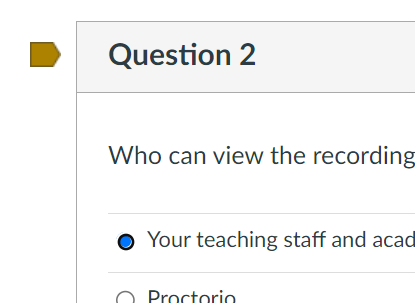
In the upper right-hand corner of the screen is a list that indicates which questions you’ve answered and which you’ve flagged.
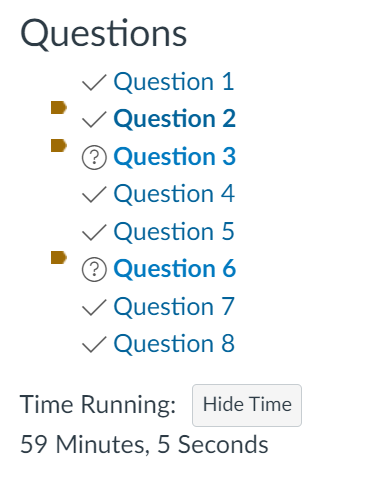
Clicking on a question number brings you to that question. Below the list is a hidable “Time Remaining Clock.”
You can test this functionality out in the Proctorio Setup Quiz (that’s actually where these screenshots come from). It can be very helpful with time management!
Solution Recordings, Formula Sheet, Condensed Slides, etc.
Section titled “Solution Recordings, Formula Sheet, Condensed Slides, etc.”If you’ve downloaded Bruce’s slides, you may have noticed that he repeats a great deal of information as he builds slides. I make condensed slides that are often 40% shorter because I remove the redundant material. They can save resources if you print out the slides to review.
An additional page on this site includes information about Solution Recordings, Formula Sheet, Condensed Slides, etc. Here is a direct link to the file share: robmunger.com/2700share.
🙋 “I learned from taking a previous class with you, that I needed to be able to speed up for the exams so I adjusted my study method.”
How to use this Study Guide
Section titled “How to use this Study Guide”The page you are reading is one of more than one hundred pages in this study guide. To see how to read the other pages, please watch my review session during the last class meeting.
Alternatively, you can just review the 🧭 Finding Things page on this site.
↖ Please take a moment to explore some of the helpful links in the navigation bar! You can always get back to this site by bookmarking the following link: 2700.robmunger.com
Exam anxiety
Section titled “Exam anxiety”During the actual exam, keep your head down, keep moving forward, no matter what, and you’ll be fine.
- When necessary, just draw your attention back to the problem on the screen.
- If you get behind time-wise, consider making your best guess and moving on to the next question.
- Keep an eye on the clock, but try not to focus too much on it.
- Rinse and repeat until the clock runs out. One foot in front the other!
Feedback? Email robmgmte2700@gmail.com 📧. Be sure to mention the page you are responding to.