🙋 Student Q&A (Lecture 4)
Click here to learn about timestamps and my process for answering questions. Section agendas can be found here. Email office hour questions to robmgmte2700@gmail.com. PS1Q2=“Question 2 of Problem Set 1”

📅 Questions covered Saturday, Feb 21
Section titled “📅 Questions covered , Feb 21”🕣 1:00ish
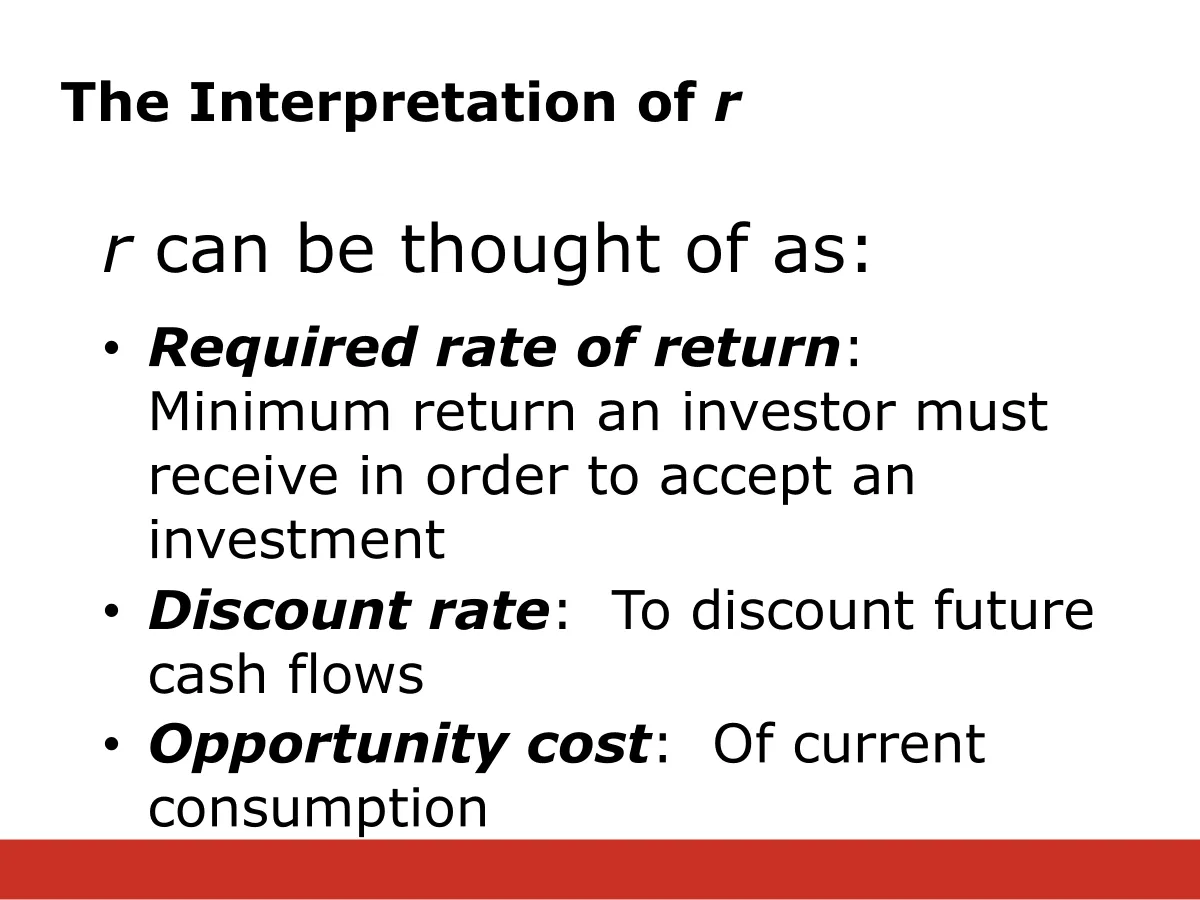
❔ There are many names for r.
✔Hurdle = required rate of return:
🕣 1:14pm
❔ NPV in Excel
✔ In video 1:14pm - 1:49pm
🕣 1:49p
❔ Can you use multiple different approaches/tools in the same situation? Course vs. Job.
✔ The question here is whether or not you can use multiple different tools in the same situation. For example, could you use Payback Period and NPV at the same time? Absolutely, you can. I believe you should.
NPV is better than Payback Period, but I could still imagine Payback Period being useful. NPV tells you the overall profitability of a project, but it can be reassuring to know, “Okay, we’ll at least get all of our initial capital back after a certain time.” Plus, these decisions are not made by individuals in larger organizations; they’re made by teams. NPV, sorry, Payback Period, is something you can easily communicate to others.
All of these are data points. NPV is, to some degree, the last word, but all of them are data points that you can use to build a larger picture of what’s going on.
🕣 1:51pm
❔ If we have a decrease in assets (e.g., an uninsured theft of inventory, or a failure in collecting accounts receivable), how would this impact equity? My guess is that it has to impact equity, since the balance sheet needs to be balanced. But the impact is indirect, because losing inventory doesn’t automatically reduce equity. I believe it decreases the net income earned after a few months (because you can’t sell the stolen inventory), which will then decrease net income, so the firm is less able to accumulate retained earnings, which will then in turn decrease equity and even out the balance sheet. Is this thinking correct? But what if my inventory is stolen on December 30 and the balance sheet is drafted on December 31. In this case, one day wouldn’t be enough to impact net income and retained earnings, so the balance sheet would be unbalanced. This feels weird to me. But is this so?
✔
🕣
❔ I was wondering for the homework, when we are dealing with negative values should we use “-“ or parentheses? Also, for figures that are in thousands, do we need to use commas?
✔ Always use minus. This isn’t an accounting class, so Bruce hasn’t taught the convention with parentheses. You only use what Bruce teaches.
Always use minus.
Don’t use commas.
Just put the numbers in in the simplest form possible $5M → 5000000
📅 Questions covered Monday, Feb 23
Section titled “📅 Questions covered , Feb 23”🕣 7:40pm
❔ How do I see how I did in PSs and review my answers?
✔ https://canvas.harvard.edu/courses/166588/files/24299948?module_item_id=2112334
🕣 7:43pm
❔ For our next TA session, I’d like to go over the spreadsheet together and review our current cash flow. This will help ensure everything is organized and aligned before we move forward.
✔ https://2700.robmunger.com/l3/withaspreadsheet/
🕣 9:24pm
❔ I was reviewing this week’s slides and had a question on NPV. Specifically, would we only accept projects with a positive NPV or a project with a NPV of zero or greater? Suppose the NPV was zero, would this not just mean we’re getting exactly what we paid for from the project?
✔ Yes, you’re understanding this perfectly. If the NPV is zero, there’s no point in doing the project, but there’s no point in not doing the project. In this class, we’re going to think of the business as being indifferent between taking the project and not taking the project, because we want to think of net present value as being equivalent to the change in shareholder value, and that’s a good way to think of it. We’re using a mathematical model there, so we can draw conclusions, but I will say that, in the real world, you’d want to add more nuance.
Companies only have so much bandwidth, and so most companies wouldn’t take on a project with an NPV of zero. Specifically, they have limited staff, and there are management costs. There are a lot of other implicit costs that maybe don’t get factored in otherwise, and so they wouldn’t, but you’re thinking about it exactly right. In this class, the official answer is that it’s ambiguous, but really we don’t care about this question, and so we’ll kind of do whatever is most convenient for the individual problem. You don’t have to worry about this; you’re never going to gain or lose points on this. The fact that you’re even thinking about it is great; just kind of go with the flow, and all will be good.
🕣 9:26pm
❔ How to prepare for the midterm.
✔ Bruce deliberately doesn’t tell you what is on the exam, because he wants you to know all of it. He considers any slide that he covers to be “fair game” on the exam. With that said, he does seem less interested in testing individual facts and figures on the exam. Perhaps slightly over half of the problems cover calculations, with the remainder focusing on concepts, much like on the homework.
The best indication of exam questions are the midterm and homework questions, but with some caveats:
- You’ve already done the homework and studied, so it will be far easier when you take the exam.
- His exams are carefully constructed so that you will have plenty of time if you are well prepared. To be well prepared, you should be able to do the problem set problems fairly rapidly.
🙋♀️Master the skills and understand the concepts and you’ll be good to go. With Rob’s help. Use Rob’s website, too!
1/4 Review/Foundation
Section titled “1/4 Review/Foundation”- Review equation sheet and practice with it.
- Slide review: can you explain the slides? There are some helpful examples in the slides (they often come in pairs, but he only does the first one).
- If you are stuck, the textbook can be helpful.
1/2 Practice
Section titled “1/2 Practice”- Problem sets are also reposted for practice. Be sure to use the equation sheet as you do these practice problems. Work through them as if you were taking a test, start to finish, trying to get every single possible point. Perhaps take notes on the questions you struggled with and return to those ones later.
1/4 Shore up weaknesses
Section titled “1/4 Shore up weaknesses”- Reach out to me with any questions you may have.
- If you are reviewing homework and are confused by a question, email robmgmte2700@gmail.com and I will cover it in the next section. (For example: “Please review PS 3, Q5. I didn’t get how Cost of Equity Capital was computed”)
Formula Sheet
Section titled “Formula Sheet”I’ve made a formula sheet. Practice using it as you do practice problems! Here is the link: robmunger.com/2700share
Feedback? Email robmgmte2700@gmail.com 📧. Be sure to mention the page you are responding to.