✏️ Rights Offering Example 2
Note: For an example that lays out some of the foundational concepts, see Rights Offering Example 1
🙋 Could you explain the following example? It is the final example from this lecture.
✔ Sure! Here is the full problem statement:
- You are the CFO of a company that has a market capitalization of $5 billion. The firm has 100 million shares outstanding, so the shares are trading at $50 per share.
- You need to raise $250 million and have announced a rights issue. Each existing shareholder is sent one right for every share he or she owns.
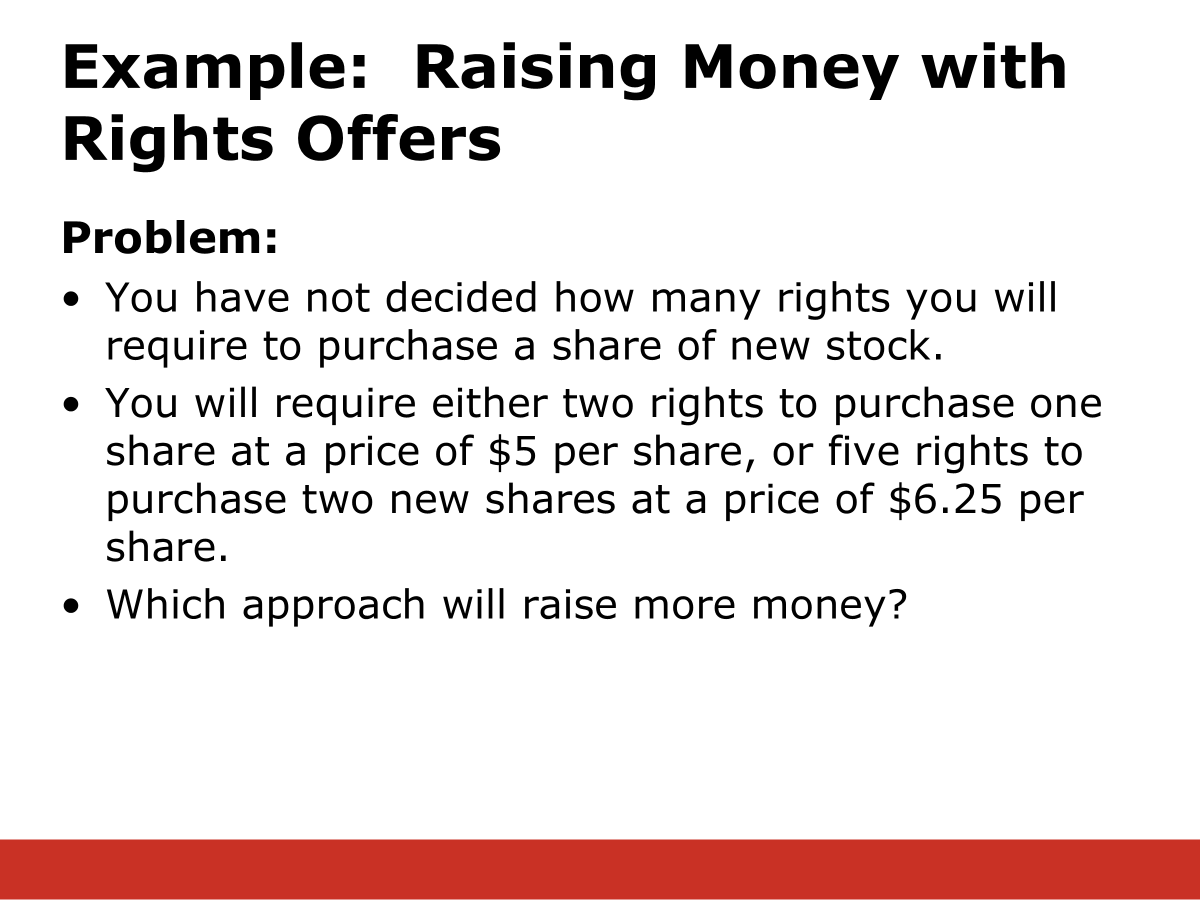
- You will require either two rights to purchase one share at a price of $5 per share, or five rights to purchase two new shares at a price of $6.25 per share.
- You have not decided how many rights you will require to purchase a share of new stock.
- Which approach will raise more money?
- How do shareholders do in the transaction?
It can be hard to analyze the “five rights to purchase two new shares at a price of $6.25 per share,” so I will introduce the idea of a “package.” Specifically, that five rights grant you a package of being able to purchase two new shares at $6.25 per share. Likewise, in option 1, you only need 2 shares for the package of being able to buy purchase 1 share for $5.
Option 1: 2 shares/rights → package → 1 share @$5
Section titled “Option 1: 2 shares/rights → package → 1 share @$5”How much money is raised?
- 100m shares/2shares per package = 50m packages.
- 50m packages × 1 share purchased per package = 50m new shares purchased @$5
- 50m × $5 = $250M
How do shareholders do?
- How much is a share worth? Company was worth MC=$5B and it raised $250M, so it is now worth $5.25B. There are now 100M + 50M = 150M total shares. We back the share price out of the market cap: P = MC/#Shares = 5.25B/150M = $35.
- How much value did the shareholders get by purchasing a share at a discount? They paid $5 for a share that is now worth $35, so they got a $30 discount for each “package.” Since there two rights are required to get this discount (ie 2 shares per package), that means that owning a share entitles an investor to a discount of $30/2shares = $15 per share. In other words, the rights offering is giving people a value of $15 per share.
- What is the total value that shareholders have after all of this has happened? They had an individual share worth $35. They received the rights offering, which gave them a $15 discount per share, so in total they were left with $50. That is exactly what they started with. This illustrates, once again, that, in some ways, you cannot create value through financial engineering.
This sounds very pessimistic until you realize the company actually needed the money, and this is how it raised it. If the company is facing distress costs, this money could help it avoid those costs and create shareholder value. In this example, we have not explicitly modeled the benefits of giving the company the cash, but if the company has a compelling need for that cash, raising the money could have had material advantages. We said the company’s market cap after the cash infusion was $5.25 billion. If it really needed that $250 million, it might have actually raised the value of the company significantly above that.
Option 2: 5 shares/rights → package → 2 shares @$6.25
Section titled “Option 2: 5 shares/rights → package → 2 shares @$6.25”Money Raised:
- 100m shares/5shares per package = 20m packages.
- 20m packages × 2 share purchased per package = 40m new shares purchased @$6.25
- 40m × $6.25 = $250M
How do shareholders do?
- How much is a share worth? Company was worth MC=$5B and it raised $250M, so it is now worth $5.25B. There are now 100M + 40M = 140M total shares. We back the share price out of the market cap: P = MC/#Shares = 5.25B/140M = $37.50.
- How much value did the shareholders get by purchasing a share at a discount? They paid $6.25 for a pair of share that is now worth $37.50×2 = $75, so they got a $75-$12.50 = $62.50 discount for each “package.” Since there 5 rights are required to get this discount (ie 5 shares per package), that means that owning a share entitles an investor to a discount of $62.50/5shares = $12.50 per share. In other words, the rights offering is giving people a value of $12.50 per share.
- What is the total value that shareholders have after all of this has happened? They had an individual share worth $37.50. They received the rights offering, which gave them a $12.50 discount per share, so in total they were left with $50. That is exactly what they started with. This illustrates, once again, that, in some ways, you cannot create value through financial engineering. However, see the “This sounds very pessimistic” paragraph above for how it could benefit people.
Note: For an example that lays out some of the foundational concepts, see Rights Offering Example 1
Feedback? Email robmgmte2700@gmail.com 📧. Be sure to mention the page you are responding to.